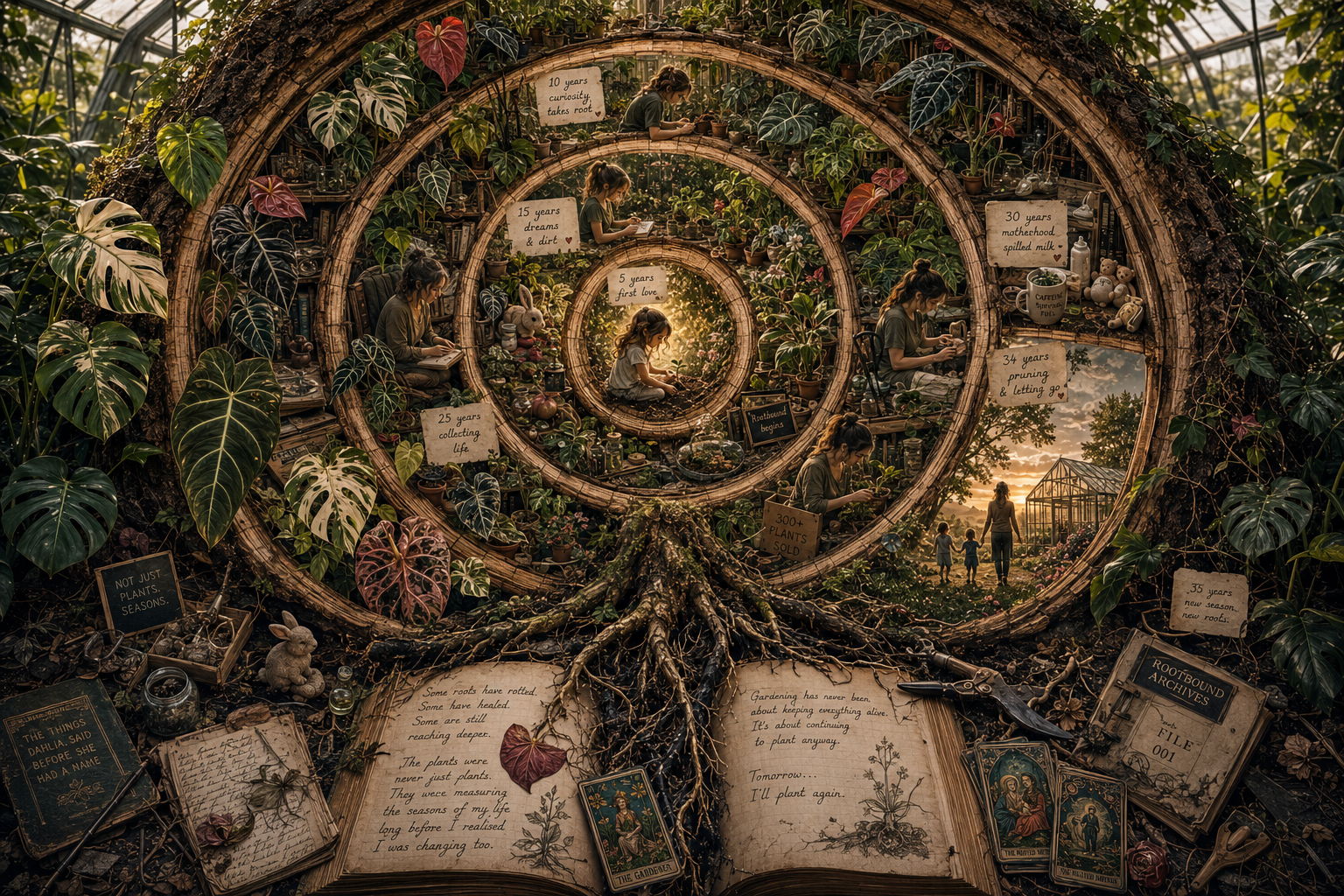
I’ve always loved plants. Long before motherhood. Long before Spilled Milk and Root Rot. Long before I knew I’d one day build a brand around them, there were gardens. There were weekends wandering through nurseries, afternoons spent repotting plants, and far too much excitement over a new leaf unfurling. I found peace in propagation, satisfaction in watching roots develop, and hope in seeing a tiny seed finally break the surface after weeks of waiting.
At the time, I thought I was simply growing plants.
Looking back, I think they were growing me.
The plants were never just plants. They were measuring the seasons of my life long before I realised I was changing too.
When I became a mother, something shifted.
Motherhood didn’t change my love of plants. If anything, it amplified it.
Without ever meaning to, my collection became a mirror. As motherhood demanded more of me, I surrounded myself with more life. More anthuriums. More philodendrons. More alocasias. More propagations. More shelves. More things to nurture.
Looking back now, I don’t think I was collecting plants.
I think I was trying to hold onto the part of me that still knew how to grow.
People often think root rot happens because a plant wasn’t loved enough.
It doesn’t.
Root rot happens because something that should sustain life is given in such abundance that the roots can no longer breathe. Too much water. Too much care. Too much of a good thing. The roots slowly suffocate beneath the surface while the leaves continue to look healthy, until one day they don’t.
The more I thought about it, the more I realised I wasn’t just describing plants anymore.
You can pour every ounce of yourself into your children, your home, everyone around you until one day you realise there’s no oxygen left around your own roots. Not because you don’t love them. Because you do. Love was never the problem.
People always notice the leaves. Almost nobody thinks to look at the roots.
They notice the tired mum. The messy house. The weight gain. The forgotten hobbies. The exhaustion. The woman who doesn’t quite seem like herself anymore.
They notice the leaves.
Very few people stop to ask what’s happening underneath.
For years, every lost plant felt personal. Every failed seed. Every cutting that never rooted. Every beautiful plant that slowly declined despite everything I tried.
The alocasias always seemed to know before I did.
When I was overwhelmed, they’d begin to struggle. Leaf after leaf would yellow, collapse and disappear. At the time, it felt like another failure. Looking back, I think I only noticed them because I was quietly looking at myself.
I lost a lot of beautiful plants.
I lost a lot of seeds before they ever had the chance to become something.
At the time, every loss hit me hard. It wasn’t really about the plants. It was about potential. About watching something I cared about disappear before it ever became what it could have been.
Now I know something I didn’t then.
Gardening has never been about keeping everything alive.
It’s about continuing to plant anyway.
I spent years trying to save every plant I owned.
Somewhere along the way, I forgot that I needed saving too.
This year I sold more than three hundred anthuriums, followed by another huge part of my collection. People expected me to be devastated.
Honestly…
I wasn’t.
Not because I’d stopped loving plants.
Because I’d remembered why I loved them in the first place.
Somewhere along the journey they had quietly stopped being a source of peace and become another responsibility. Another expectation. Another thing relying on me.
Selling them wasn’t giving up.
It was pruning.
Every gardener eventually learns that growth isn’t just about keeping everything alive. It’s about knowing what to prune, what to propagate, what to transplant and, sometimes, what to let go.
Pruning looks cruel.
Until spring comes.
Then you realise it was an act of love all along.
I think people aren’t so different.
Some versions of ourselves belong to another season. Some expectations need cutting back. Some dreams don’t germinate. Some roots simply need more room to breathe.
None of that is failure.
It’s simply part of growing.
For a long time I thought Spilled Milk and Root Rot was simply the name of a brand.
Now I think it had been quietly growing beside me for years.
Spilled Milk is motherhood.
The chaos.
The exhaustion.
The mess.
Root Rot is what happened underneath.
The invisible part.
The part nobody notices until the leaves start yellowing.
The funny thing about root rot is that it isn’t the end of the story.
If you catch it early enough, you cut away what can no longer be saved. You give the roots room to breathe again. Fresh air. Fresh soil. A little less water. A little more light.
And sometimes the plant comes back stronger than it ever was.
Not because it forgot what happened.
Because it grew new roots.
Tomorrow…
I’ll plant again.

💀🌿
Bec
Leave a Reply